
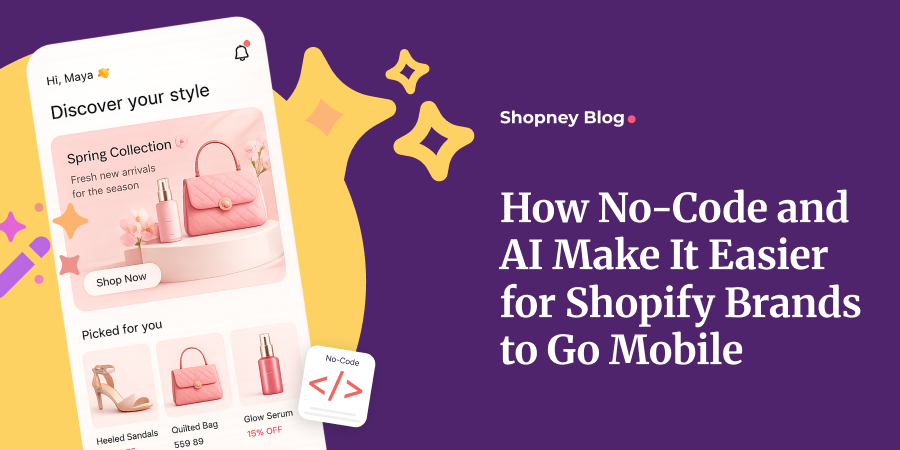

Mobile commerce is no longer limited to making a Shopify website responsive.
Today, a complete mobile commerce strategy can include two connected channels: a mobile-friendly website that helps customers discover a brand and a mobile app that gives returning customers a faster, more convenient, and more engaging way to shop.
For many years, creating that mobile app was the difficult part. Launching an app required a large budget, specialized developers, and months of planning, development, testing, and maintenance.
No-code technology has removed much of this technical complexity. More recently, AI has started simplifying app design, marketing content, customer engagement, personalization, and everyday app management.
As a result, merchants can now turn their Shopify store into a mobile app without building one from scratch, making it much easier to launch and manage a branded mobile shopping channel.
Mobile Websites and Mobile Apps Serve Different Purposes
Shopify merchants do not necessarily need to choose between a mobile website and a mobile app. The strongest mobile commerce strategies use both channels for different stages of the customer journey.
A mobile-friendly website is particularly important for:
- Search engine visibility
- Product and brand discovery
- Customer acquisition
- First-time visits
- First-time purchases
Customers can open a mobile website directly from Google, social media, an advertisement, an email, or a shared link. They do not have to install anything before browsing, which makes the mobile website an essential entry point for new shoppers.
A mobile app usually becomes more valuable after a customer has already discovered the brand. It can support:
- Higher-intent shopping
- Faster repeat purchases
- Customer retention
- Loyalty and rewards
- Personalized experiences
- Direct customer communication
A mobile app gives shoppers a dedicated environment for interacting with a brand. Customers can return directly to previously viewed products, saved items, past orders, loyalty rewards, subscriptions, personalized collections, and products they regularly reorder.
This shorter and more focused journey can also support stronger conversion performance. JMango360’s commerce data reports a mobile app conversion rate of 6.14%, compared with 1.57% for mobile websites. Actual results will naturally vary depending on the store, product category, audience, app adoption, and overall customer experience.
The important point is not that one channel should replace the other. A mobile website helps Shopify stores attract customers, while a mobile app helps them build stronger relationships with the shoppers who are most likely to return.
Recommended read: Mobile App vs. Mobile Website for Shopify: Key Differences
Why Building a Mobile App Used to Be Difficult
Traditional mobile app development was a complex technical project.
A Shopify merchant often had to coordinate with separate designers, developers, testers, project managers, and technical support teams. Even after the first version of the app was completed, the work was not finished.
The process could involve:
- Designing the complete mobile experience
- Developing separate iOS and Android applications
- Connecting the app to Shopify
- Synchronizing products, inventory, customers, and orders
- Testing the app across multiple devices
- Preparing Apple App Store and Google Play submissions
- Fixing technical issues after launch
- Maintaining compatibility with operating system updates
- Building new features whenever business needs changed
Custom development timelines could stretch from several months to more than a year, depending on the app’s complexity. Development costs could also reach tens or even hundreds of thousands of dollars when design, engineering, testing, infrastructure, maintenance, and ongoing support were included.
This made mobile apps difficult to justify for many small and growing Shopify brands. Even merchants that understood the potential benefits of an app could struggle to find the budget, technical resources, and internal time required to build one.
The problem was not simply creating the first version. A commerce app also needs regular updates, fresh content, new campaigns, stable integrations, and ongoing technical maintenance.
No-code platforms changed this by giving merchants access to an app infrastructure that was already built.
Recommended read: Custom Development vs. No-Code Mobile App Builders
How No-Code Makes Mobile App Development Easier
A no-code Shopify mobile app builder provides the technical foundation required to create, launch, and manage an app without developing every component from the beginning.
Instead of writing code, merchants can focus on the parts of the app that directly affect their customers: branding, product discovery, merchandising, promotions, and engagement.
Build the App Visually Without Coding
No-code platforms typically provide a visual editor where merchants can create and organize the app experience using configurable elements.
Depending on the platform, merchants may be able to arrange:
- Product collections
- Promotional banners
- Menus and navigation
- Product sections
- Featured categories
- Recommendations
- Campaign content
- Branded visual elements
This allows eCommerce and marketing teams to make everyday changes without submitting a development request.
A new collection can be promoted on the homepage. A seasonal banner can be replaced. Product sections can be reordered. Navigation can be adjusted around a campaign or product launch.
These changes can be handled through the platform rather than becoming separate development projects.
This does not mean that design no longer matters. It means merchants can spend more time improving the shopping experience and less time managing the code behind it.
Connect the App Directly to Shopify
A Shopify mobile app builder can connect with the merchant’s existing Shopify store and use the same eCommerce data.
Products, collections, pricing, inventory, customer accounts, discounts, and orders can be synchronized between Shopify and the mobile app. When information changes in the Shopify admin, it can also be reflected in the app without requiring the merchant to maintain two completely separate systems.
The app becomes another storefront connected to the same Shopify backend.
This is particularly important for growing brands. Managing separate product catalogs, inventory systems, customer records, and order processes would create unnecessary operational work and increase the risk of inconsistent information.
A direct Shopify connection allows the merchant to add a mobile app to the business without rebuilding the entire eCommerce operation around it.
Launch and Update the App Faster
Because much of the infrastructure already exists, no-code development can significantly shorten the path to launch.
Merchants can spend their time on:
- App branding
- Homepage design
- Navigation
- Product merchandising
- Integration setup
- Testing
- App store preparation
- Launch campaigns
The platform handles much of the technical framework underneath these decisions.
The same advantage continues after launch. Merchants can update banners, collections, navigation, layouts, and promotional content through the app builder instead of waiting for a development team to release a new version for every change.
This is especially valuable in eCommerce, where campaigns, collections, inventory, and customer priorities can change quickly.
A mobile app needs to keep up with the store. No-code tools make that ongoing management more practical.
No-Code Makes Going Mobile Easy. AI Makes It Effortless
No-code removes the technical work involved in launching a mobile app. AI takes it further by reducing the manual work needed to design, launch, market, and manage it.
Instead of starting from a blank screen, merchants can have a polished mobile app created using the products, collections, branding, and content already available in their Shopify store.
Once the app is live, AI can continue working behind the scenes through marketing automation, in-app chat, design updates, personalization, and ongoing optimization.
Shopney is moving toward bringing these capabilities together in one platform, making it possible for merchants to launch a beautiful mobile app and keep it running smoothly with far less manual effort.
The result is more than a faster way to build an app. It is an increasingly automated mobile sales channel designed to deliver better customer experiences and stronger results.
Launching an App Is Easier, but Strategy Still Matters
No-code and AI have lowered the technical barrier to launching a mobile app. They have not removed the need for a clear mobile app strategy.
Simply publishing an app does not guarantee that customers will download it, return to it, or purchase through it.
Merchants still need to answer two important questions:
- Why should a customer download the app?
- Why should they continue using it?
A strong reason to download might include:
- An app-exclusive discount
- Early access to new products
- Members-only collections
- Loyalty points or rewards
- Faster access to frequently purchased products
- Exclusive mobile content or experiences
After installation, the app must continue delivering value.
That may come from personalized recommendations, saved customer information, convenient repeat purchasing, relevant push notifications, loyalty visibility, subscriptions, wish lists, or a faster overall shopping journey.
The most effective app strategies do not treat the app as a smaller copy of the mobile website. They use the capabilities of the app to create an experience specifically designed for engaged and returning customers.
As creating an app becomes easier, this strategic difference becomes even more important. When more brands can launch an app, the quality and usefulness of the experience become the real competitive advantage.
How to Choose the Right Shopify Mobile App Builder
No-code mobile app builders can vary significantly in quality and capability.
A reliable Shopify mobile app builder should give you the flexibility to create a professional, on-brand app while managing the technical complexity in the background.
Choose a platform that provides:
- Reliable support throughout the design, launch, and post-launch stages
- A fast, flexible, and user-friendly design editor
- Push notification capabilities
- Various AI and automation capabilities
- Segmentation and personalization features
- In-app campaigns
- Integrations for loyalty, reviews, subscriptions, search, analytics, and more
- The ability to preview your app before publishing
- Transparent pricing without unexpected development fees
The right no-code platform should do more than help you publish an app. It should make it easy for your team to manage, optimize, and grow the app over time.
This is especially important for Shopify stores because a mobile app is not a one-off project. It is an ongoing sales and retention channel that must remain relevant, updated, and connected to your customers.
How Shopney Simplifies Mobile App Growth
Shopney is a top-rated mobile app builder for Shopify and Shopify Plus brands that want to launch a fully branded iOS and Android app without custom development.
It brings app design, Shopify synchronization, customer engagement, and ongoing support together in one platform.
With Shopney, merchants can use:
- One-click AI app design
- AI marketing automation
- AI in-app chat
- AI design updates
- Drag-and-drop customization
- Support before, during, and after launch
- Real-time Shopify synchronization
- Free, unlimited AI-powered push notifications
- Customer segmentation and automation
- Targeted in-app campaigns
- Loyalty, reviews, subscriptions, search, marketing, and analytics integrations
The AI-powered design process gives merchants an immediate starting point using their existing Shopify store. They can then customize the app through a visual editor to match their branding, products, collections, and merchandising strategy.
After launch, merchants can continue updating the experience, creating campaigns, sending push notifications, and connecting the app with the wider ecommerce technology stack.
Shopney simplifies the technical side of mobile app creation while helping merchants focus on what happens after the launch: increasing conversion, strengthening customer engagement, encouraging repeat purchases, and improving retention.
Final Thoughts
A mobile-friendly website and a mobile app perform different but connected roles.
The mobile website helps a Shopify store attract new visitors, support product discovery, and convert first-time customers. The mobile app gives engaged shoppers a faster and more direct way to return, purchase again, interact with loyalty programs, and stay connected with the brand.
In the past, launching that app required a significant budget, a development team, and months of technical work.
No-code platforms made mobile app development faster and more accessible by providing the infrastructure merchants previously had to build themselves. AI is simplifying the process even further by accelerating app design, campaign content, personalization, customer engagement, and ongoing management.
Shopify merchants can now create a mobile app without starting from scratch.
The biggest opportunity is no longer simply being able to launch an app. It is being able to spend less time managing technical complexity and more time creating a mobile shopping experience that gives customers a reason to return.


Share this: