
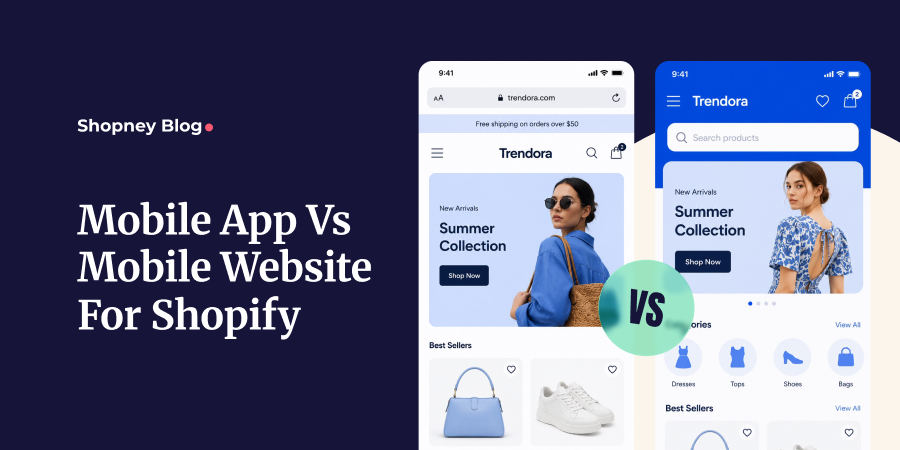

Most customers now use mobile devices to discover products, compare options, and shop online. That makes a mobile-responsive website essential for every Shopify store.
But a mobile-friendly website is only the starting point.
A mobile website helps people discover your brand and access your products easily. A mobile app for Shopify is built for customers who already know your brand and want a faster, more convenient way to return.
That is the main difference.
A mobile website supports discovery and customer acquisition. A mobile app supports conversion, repeat purchases, and customer retention.
Shopify brands do not need to choose between the two. They need both channels to support different stages of the customer journey.
Mobile app vs. mobile website for Shopify: The main difference
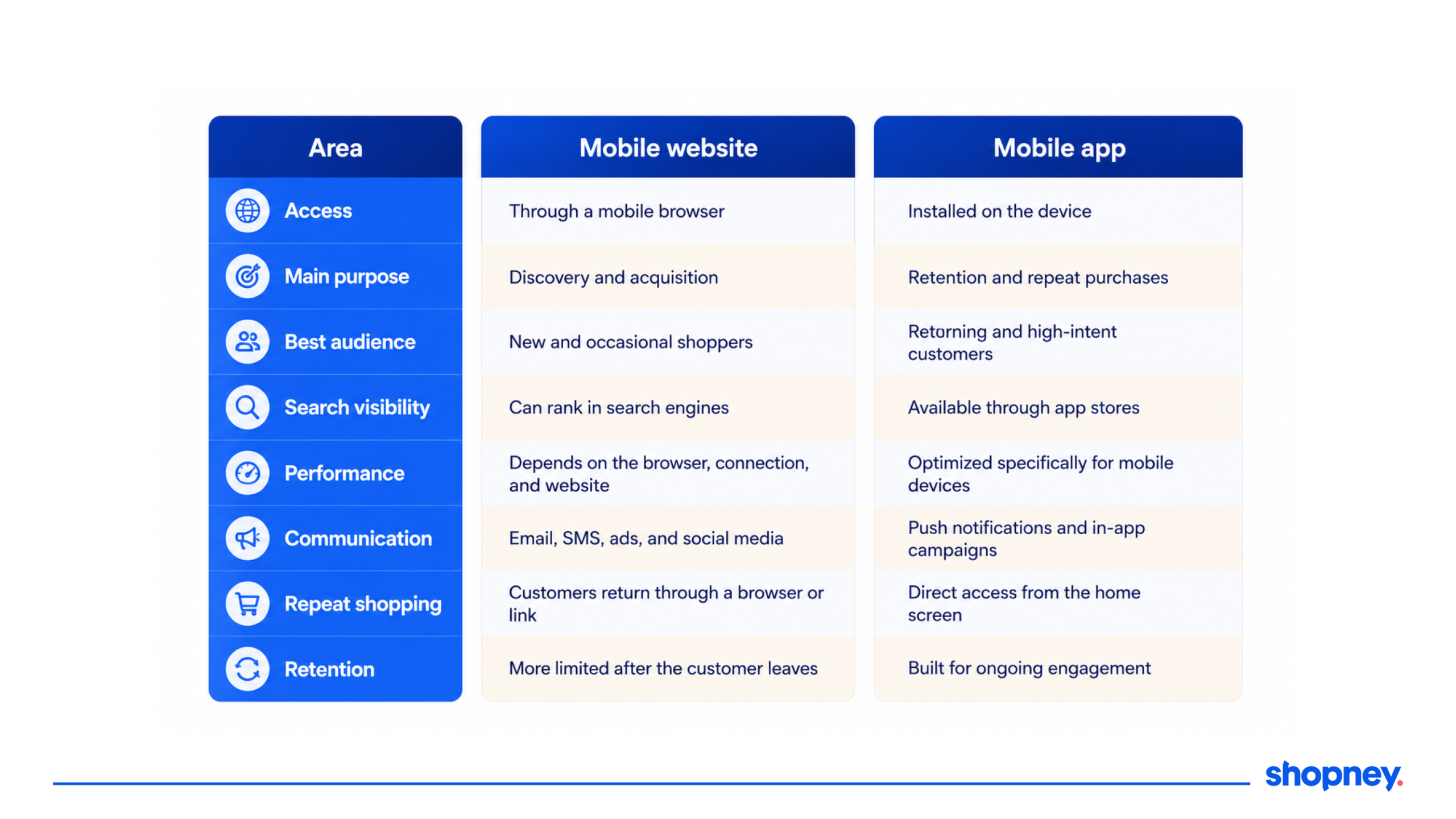
A mobile website is accessed through a browser such as Safari or Chrome. Customers can reach it through search engines, social media, advertisements, emails, or direct links without downloading anything.
A mobile app is installed on the customer’s device. It gives returning shoppers direct access to the brand, along with features such as push notifications, saved accounts, wishlists, loyalty rewards, subscriptions, and personalized content.
In simple terms:
A mobile website helps customers find your brand. A mobile app gives them a better reason and an easier way to return.
What is a mobile-friendly Shopify website?
A mobile-friendly Shopify website is a responsive version of your online store that adjusts to different mobile screen sizes.
Its biggest advantage is accessibility. A new customer can tap a link, explore your products, and make a purchase immediately without installing an app.
This makes a mobile website particularly important for:
- Search engine visibility
- New customer discovery
- Paid and organic traffic
- Social media and influencer links
- First-time purchases
However, the experience still happens inside a browser. Customers may need to search for your store again, wait for pages to reload, log back into their accounts, or move through the entire shopping journey each time they return.
Once they leave, bringing them back often depends on email, SMS, social media, or paid advertising.
What is a Shopify mobile app?
A Shopify mobile app is a branded shopping app that customers download from the Apple App Store or Google Play.
It connects with your Shopify store and gives customers direct access to your products, collections, accounts, orders, loyalty rewards, subscriptions, and other shopping features.
Unlike a website, the app remains visible on the customer’s home screen. They do not need to open a browser, search for the store, or find an old link.
A mobile app is especially valuable for:
- Returning customers
- Repeat buyers
- Loyalty members
- Subscribers
- Customers who regularly reorder
- Highly engaged brand followers
Downloading an app requires more commitment than opening a website. That is also what makes app users valuable. They already know your brand and have shown a stronger level of interest in continuing the relationship.
Mobile app vs. mobile website: Quick comparison
-
Speed and performance:
Mobile websites depend on the customer’s browser, internet connection, theme, scripts, image sizes, server response, and third-party tools.
Every page may need to reload product data, images, scripts, and design elements. Even a well-optimized website can become slower as more features and apps are added.
Mobile apps are designed specifically for mobile devices. They can use cached content, locally stored elements, and mobile-optimized navigation to make interactions feel faster and more responsive.
Customers can move between collections, products, accounts, carts, and previous orders with fewer interruptions.
This matters because every delay adds friction. A faster shopping experience makes it easier to browse products, compare options, and continue toward checkout before attention is lost.
-
User experience and engagement:
A mobile website is convenient for first-time visitors because it requires no installation. However, customers are still shopping inside a browser filled with tabs, search results, notifications, and competing websites.
A mobile app creates a dedicated environment for your brand.
Customers can open the app and quickly access:
- Saved accounts
- Wishlists and favorites
- Previous orders
- Loyalty rewards
- Subscription products
- Personalized recommendations
- App-exclusive offers
Instead of starting the journey again each time, customers can continue from where they left off.
That makes the experience feel smoother, more personal, and more convenient.
-
Customer communication and marketing costs:
A Shopify store with only a mobile website often depends heavily on paid ads, email, SMS, and social media to bring customers back.
These channels remain valuable, but they have limitations. Paid ads can become expensive, emails can disappear inside crowded inboxes, and SMS messages have a direct sending cost.
A mobile app gives the brand another owned communication channel through push notifications.
Push notifications can be used for product launches, back-in-stock alerts, abandoned carts, loyalty updates, personalized recommendations, seasonal campaigns, and app-exclusive offers.
The customer can tap the notification and move directly into the relevant product or campaign inside the app.
A mobile app does not replace advertising, email, or SMS. It reduces your dependence on them by making it easier to reach customers who already know your brand without repeatedly paying for their attention.
-
Conversion rates and purchase behavior:
Mobile apps can create stronger conversion conditions for two main reasons.
First, the experience is usually faster and more focused. Customers face fewer browser distractions and can move from product discovery to checkout with less friction.
Second, app users are often higher-intent customers.
Someone who downloads your app may already be an existing customer, loyalty member, subscriber, regular website visitor, or engaged social media follower. They are not necessarily learning about the brand for the first time.
They already know what you offer and are more open to purchasing.
A mobile app gives you the opportunity to turn that existing interest into more conversions through relevant recommendations, app-exclusive offers, personalized campaigns, and a consistent shopping experience.
Launching an app alone does not guarantee stronger results. The app still needs clear navigation, updated content, relevant communication, and an easy path to checkout.
Mobile apps can also significantly outperform mobile websites in conversion.
According to Shopney merchant data, Shopify stores using Shopney achieve an average of 5x higher conversion rates in their mobile apps than on their mobile websites.
-
Repeat purchases and customer retention:
A mobile website can support repeat purchases, but returning often requires more effort.
A customer may need to open their browser, search for your store, wait for the website to load, log in again, find the product, and rebuild their cart.
None of these steps is difficult on its own. Together, they create enough friction for a customer to delay the purchase or forget about it completely.
A mobile app shortens the journey.
Customers can return directly to products they viewed before, saved items, past orders, subscriptions, loyalty rewards, personalized collections, and products they regularly reorder.
You can also give them relevant reasons to return through push notifications, back-in-stock alerts, app-exclusive offers, loyalty reminders, and in-app campaigns.
Retention improves when returning feels easy and worthwhile. A mobile app is designed to make that happen.
-
Average order value:
A mobile app can also support higher average order value by showing customers more relevant products while they are already engaged.
This can include personalized recommendations, frequently bought together products, cross-sells, upsells, bundles, subscriptions, loyalty incentives, and cart-based suggestions.
The advantage is that app users are usually warmer than first-time website visitors.
They already know the brand, have shown interest, and may have purchased before. This makes it easier to recommend a relevant next product without interrupting the shopping journey.
The goal is not to show customers more products for the sake of it. It is to help them build a better and more complete basket.
Does a mobile app replace a Shopify mobile website?
No.
A mobile app should not replace your Shopify mobile website.
Your website remains essential for search engine traffic, paid advertising, social media links, first-time visitors, and customers who do not want to install an app.
The mobile app supports the next stage of the relationship.
It is designed for customers who already know your brand and want a faster, easier way to return and shop again.
The website introduces customers to the brand. The app helps turn those customers into repeat buyers.
Mobile website or mobile app: Which one does your Shopify store need?
You should not treat mobile websites and mobile apps as competing channels.
They perform different jobs.
A mobile website supports:
- Reach
- Discovery
- Search visibility
- Customer acquisition
- First-time purchases
A mobile app supports:
- Higher-intent shopping
- Repeat purchases
- Customer retention
- Loyalty
- Personalization
- Customer lifetime value
- Direct communication
The strongest mobile commerce strategy uses the website to attract customers and the app to retain and grow the most valuable ones.
When should a Shopify store launch a mobile app?
A new Shopify store with limited traffic and very few customers may need to focus first on acquisition and brand awareness.
A mobile app becomes more valuable once there is an audience to retain.
Your store may be ready when it has:
- Consistent mobile traffic
- A growing returning customer base
- Repeat-purchase products
- An active loyalty or subscription program
- A strong social media community
- Customers who regularly reorder
- Frequent product launches or restocks
- High paid remarketing costs
You do not need to meet every condition. However, the more returning customers and repeat-purchase opportunities you have, the more valuable an app can become.
How to launch your Shopify mobile app
There are two main ways to build a Shopify mobile app: custom development or a no-code mobile app builder.
A custom mobile app gives you complete control, but it is expensive, takes longer to launch, and creates more technical responsibility. Every feature, integration, update, bug fix, and operating system change must be developed and maintained over time.
Unless your store requires highly unusual custom functionality, a no-code mobile app builder is usually the more practical option.
A no-code platform allows you to launch a native iOS and Android app without building everything from scratch. It provides a faster, more flexible, and lower-risk path to launching and managing your mobile app.
For a deeper comparison, read our guide to no-code vs. custom mobile apps for Shopify stores.
Building a Shopify mobile app with Shopney
Shopney is a no-code mobile app builder created for Shopify and Shopify Plus stores that want to launch branded native iOS and Android apps without custom development.
With Shopney, you can sync your Shopify store, customize your app design, connect your ecommerce tools, and manage your mobile shopping experience through one platform.
Shopney is a strong fit for brands that want to:
- Launch a branded app quickly with an AI-powered app builder
- Receive support before, during, and after launch
- Send free push notifications, including personalized, segmented, abandoned cart, and back-in-stock messages
- Connect loyalty, subscription, review, search, and marketing integrations
- Create in-app campaigns that guide customers toward relevant products and offers
Last thoughts
A mobile-responsive website is essential for every Shopify store, but it is only the foundation of a complete mobile commerce strategy.
The mobile website helps customers discover your brand and explore your products without downloading anything.
The mobile app gives customers who already know and trust your brand a faster, smoother, and more direct way to return.
Shopify stores do not need to choose between a mobile website and a mobile app.
They need both.
The mobile website supports discovery and customer acquisition. The mobile app supports conversion, repeat purchases, retention, and customer lifetime value.
Together, they create a stronger mobile shopping journey from the first visit to every purchase that follows.
Share this: