

Guest post by Blend Commerce, a Shopify CRO agency and Shopney partner. Edited by Lara Soley.
A mobile app changes the CRO job slightly.
The fundamentals are the same as they are on a website: reduce friction, make the offer clear, handle objections, and give customers a good reason to buy.
The big difference with an app is that it usually serves a warmer audience. Many users will already know your brand. In fact, many will have bought from you before, and some will use the app specifically because it is easier than returning to the website each time.
So, your mobile app should not simply copy the website experience onto a smaller screen. Its UX should make the parts of shopping that happen repeatedly feel easier: finding products, rebuilding a basket, checking out, tracking an order, reordering, using rewards, and coming back when there is a relevant reason to do so.
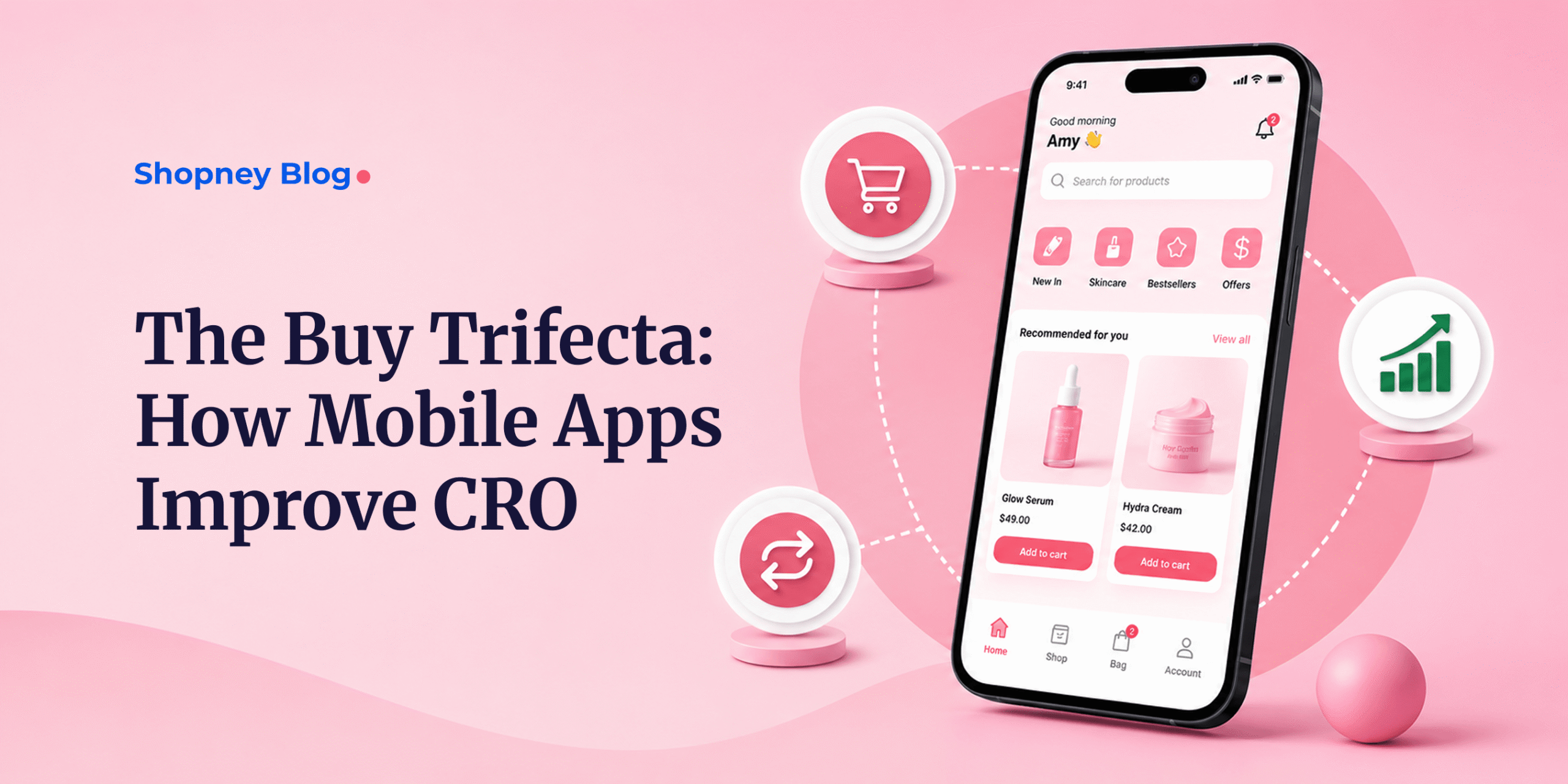
At Blend Commerce, we use the Buy Trifecta® as the framework to both assess ecommerce growth and create strategy. It helps you frame every CRO decision commercially, whether it is for a website or a mobile app for Shopify:
- Buy now: Help more shoppers complete a purchase.
- Buy more: Increase order value by helping customers build a better basket.
- Buy again: Improve retention, repeat purchase, and lifetime value.
If it sounds simple, that is because it is, and it is why we love it. And yes, we came up with it before the neat rule-of-three thing became a generative AI tell.
We apply the Buy Trifecta® to every website we work on, but if you are using a platform like Shopney to build your own mobile app, this framework is also a great way to ensure your app is conversion-ready.
Buy Now: Make the Buying Journey Easier
The first job is conversion. Get more people to buy now.
In an app, this usually means making the main buying tasks quicker than they are on the mobile site. That might sound basic, but it is where a lot of apps underperform.
A customer downloads the app, opens it, and finds the same broad homepage, the same generic navigation, the same product listing structure, and the same amount of work needed to reach checkout.
The app has to earn its place by reducing effort.
Start with the most common buying paths. If you have bestselling products, replenishable items, new drops, or seasonal collections, those should be easy to reach from the app home screen.
If customers regularly return to the same category, recently viewed products and previous purchases should be visible without requiring them to dig through an account area.
Product pages need the same discipline.
Mobile app product detail pages are often too visually busy, with reviews, bundles, delivery information, loyalty prompts, payment messaging, and product copy crammed into a screen that cannot comfortably accommodate them all.
The priority should be clear:
- What is the product?
- Why is it right for me?
- What do I need to choose?
- When will I get it?
- What happens if it’s not right?
- How do I buy it?
If those answers are scattered across accordions, banners, icons, and app blocks, the customer has to work too hard.
Then there is the cart.
Inside an app, the cart should feel like a practical buying tool rather than a holding page. It should show customers what they have selected, whether they are close to a useful threshold such as free shipping, whether anything needs attention, and how to check out with the least possible effort.
For buy now, the best CRO work is often fairly unglamorous: removing small points of hesitation that add up across the mobile journey.
That is how brands can increase mobile app conversions: not by adding more elements to every screen, but by making the next useful action clearer and easier.
Buy More: Help Customers Build a Better and Bigger Basket
Average order value is often treated too bluntly.
Brands add a cross-sell carousel, display a free-shipping bar, create a bundle, and call it an AOV strategy.
A mobile app gives you more useful ways to increase order value because you are more likely to identify the customer and work with a larger set of data points.
You might know:
- what they bought last time
- what they recently viewed
- what they added to a wishlist
- which categories they browse
- whether they respond to loyalty incentives
- which products they purchase together
All that data and the context it provides should change the way you present upsells.
A good app upsell should help the customer complete the purchase they are already making while adding useful and relevant products.
For a skincare brand, that might mean helping the customer build a routine.
For a food brand, it might mean increasing quantity based on likely consumption.
For a fashion brand, it might mean showing products that work with the item already in the cart.
For a pet brand, it might mean pairing a repeat purchase with treats or accessories that suit the same pet profile.
You get the picture.
A common pitfall is always defaulting to the product page.
The product page is often relevant, but it is not always the best place to increase AOV. A shopper who is still deciding whether to buy may not need extra options yet.
The better moment may be:
- immediately after add-to-cart
- inside the cart
- after a relevant threshold is reached
- when the customer returns to the app
- when a previous session can be continued
- when a loyalty benefit becomes available
Useful app-based AOV opportunities include:
- bundles that reflect how customers actually use the products
- cart recommendations based on the item just added
- free-shipping progress messages that are specific and easy to act on
- loyalty prompts showing what the customer unlocks by adding one more item
- subscription or reorder options for products purchased on a cycle
- wishlist reminders when the customer is already shopping in a related category
- personalized product recommendations based on previous behavior
The right Shopify mobile app integrations can support these experiences by bringing subscriptions, loyalty, reviews, search, personalization, and product recommendations into the app journey.
Measurement should go beyond AOV alone.
Track:
- attach rate
- units per order
- bundle conversion
- subscription take-up
- free-shipping threshold completion
- margin
- incremental revenue per session
AOV growth is only useful if it improves commercial quality, not simply basket size.
This is one reason we built the Buy Trifecta® benchmarking tool.Conversion rate on its own does not tell the whole story. A store can convert well and still miss growth opportunities if order value and repeat purchase are weak.
The tool is completely free and provides a fully individualized, AI-driven assessment of your store relative to your exact niche. It takes around two minutes.
Buy Again: Give Customers a Useful Reason to Return
Retention is where a mobile app can be especially useful, but only if you handle it carefully.
The most obvious advantage is push notifications.
The risk is using them as a louder version of email: more reminders, more discounts, and more “last chance” messaging.
That may create short-term revenue, but it can also train customers to wait for offers or simply switch notifications off.
Instead of starting with what you want to tell customers, your retention strategy should start with the customer’s reason to return.
Stand in their shoes when you plan it.
For replenishable products, the app can support reorder reminders based on likely usage.
For fashion or beauty, it might support:
- wishlists
- launch access
- back-in-stock alerts
- personalized recommendations
- loyalty rewards
- app-exclusive offers
For food, supplements, home, or pet products, it might help customers manage repeat purchases more easily.
If you have a loyalty program, the app can make points, rewards, and progress more visible than they often are on a website.
A mobile app brings these retention efforts together in a more accessible shopping environment. Customers can check rewards, receive timely push notifications, access exclusive offers, and return to the brand without searching through an inbox or paid platform.
This is how brands can retain Shopify customers with a mobile app by making repeat engagement easier and more useful.
Post-purchase is still part of CRO too.
Order tracking, delivery updates, care instructions, usage guidance, review requests, and reorder prompts all affect whether the customer buys again.
These moments are often treated as operational messages, but they shape the customer’s confidence in the brand.
The app should also separate commercial and non-commercial reasons to open it.
If every interaction is a sales message, engagement will be shallow.
Useful content can help, as long as it is genuinely connected to the product. Examples include:
- recipes
- styling advice
- product routines
- care guides
- fit guidance
- tutorials
- how-to content
- product education
All of these can support repeat purchases when they are specific and practical. You only need a little imagination to put this to work.
For buy again, the key metrics include:
- repeat purchase rate
- purchase frequency
- customer lifetime value
- push opt-in rate
- push-attributed revenue
- notification unsubscribe rate
- app uninstall rate
- loyalty engagement
- time between orders
Used well, push notifications and app-based retention can also help brands reduce marketing costs with a mobile app by bringing customers back without paying for every return visit.
Find the Constraint Before Adding More Features
The Buy Trifecta® is useful because it stops you from treating your app as a list of features.
If app users are browsing but not buying, the constraint is probably in buy now.
Look at:
- navigation
- search
- product page clarity
- cart usability
- checkout friction
- app speed
- product discovery
If app users convert but order values are low, focus on buy more.
Review:
- bundles
- cart recommendations
- free-shipping thresholds
- loyalty incentives
- subscription prompts
- product relationships
- upsell timing
If app users buy once but do not return, focus on buy again.
Look at:
- post-purchase communication
- reorder journeys
- push relevance
- loyalty visibility
- app-exclusive value
- product education
- practical reasons to reopen the app
It is important to approach app CRO in this logical order.
If you are struggling to get people to buy in the first place, there is little value in putting all your resources into building a world-class retention strategy.
Progress through the Buy Trifecta® from start to finish:
Buy now → Buy more → Buy again
A structured CRO audit can help identify where the constraint is, whether that is on your website, inside the app, or across the wider customer journey.
A Mobile App Should Strengthen the Entire Growth System
The commercial role of a mobile app is fairly straightforward.
It should make it:
- easier for customers to buy now
- easier to build the right combination of products
- easier to return when there is a relevant reason
If it does those three things well, the app becomes part of the growth system rather than just another channel to maintain.
It supports conversion by reducing friction.
It supports order value by making recommendations more relevant.
It supports retention by giving customers useful reasons to return.
And it can increase mobile app engagement by connecting campaigns, content, loyalty, personalization, and direct communication inside one focused shopping environment.
So yes, it is a rule of three, and it is neat.
The Buy Trifecta® also happens to work.
Try it when you are thinking about CRO for your mobile app and see for yourself.
And if you want to explore how Shopney can help you build a mobile app around conversion, engagement, and retention, Book a demo with Shopney.

Share this: