
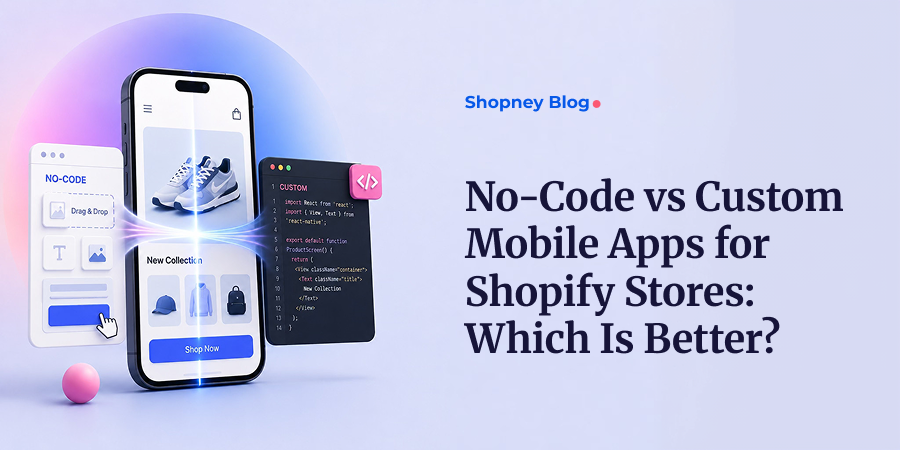

For a growing Shopify brand, launching a mobile app is no longer just a “nice-to-have” idea. It can become a stronger sales channel, a better retention tool, and a more direct way to bring loyal customers back to your store.
But once you decide that a mobile app makes sense, the next question is usually harder: should you build a fully custom app from scratch, or use a no-code mobile app builder?
Both options can give your Shopify store an iOS and Android app. Both can create a more convenient shopping experience for customers. But they are not built for the same needs, timelines, budgets, or teams.
Custom mobile app development gives you full control and flexibility, but it usually requires a larger investment, longer development time, and ongoing costly technical maintenance.
Turning your Shopify store into a no-code mobile app on the other hand, allows Shopify merchants to launch faster, manage the app without developers, and use ready-made ecommerce features that already work with Shopify.
This article breaks down the real differences between no-code and custom mobile app development for Shopify brands, so you can understand what each option offers, where each one makes sense, and which path is more practical for your business.
What Is No-Code Mobile App Development for Shopify?
No-code mobile app builders let Shopify stores create a mobile app without writing code or building everything from scratch.
Instead of hiring developers to build a custom app, the merchant uses a mobile app builder that connects directly to Shopify.
Products, collections, inventory, customers, and orders are synced from the store, so the mobile app can work as a branded mobile sales channel.
From there, the merchant can customize the app design, enable mobile shopping features, connect key integrations, and launch the app on iOS and Android through a managed platform.
What No-Code Mobile App Builders Usually Include
A no-code Shopify mobile app builder typically gives merchants:
- Shopify sync for products, collections, inventory, customers, and orders
- Drag-and-drop design to customize the app without developers
- Native iOS and Android apps for the App Store and Google Play
- In-app chat to engage with customers inside the app
- Push notifications to bring customers back
- Wishlist or favorites to help customers save products
- Integrations for loyalty, reviews, subscriptions, search, analytics, and support
- Technical maintenance and app updates handled by the mobile app builder
The main advantage is that Shopify brands can launch a mobile app faster, with less technical work, and start using it for mobile shopping, retention, and repeat purchases without managing a full development project.
What Is Custom Mobile App Development for Shopify?
Custom mobile app development means building a Shopify mobile app from scratch with developers.
This gives the brand more control over the app’s structure, design, features, backend logic, integrations, and customer experience. But it also makes the project more complex, more expensive, and more dependent on technical resources.
Custom development is usually considered when a Shopify brand needs an app experience that cannot be created with existing Shopify apps or no-code mobile app builders.
What Custom Mobile App Development Usually Involves
A custom Shopify mobile app project typically includes:
- Discovery and technical planning to define what the app should do
- UX/UI design to create the app screens and customer journey
- iOS and Android development or cross-platform app development
- Shopify API integration to connect products, collections, carts, customers, and orders
- Custom backend setup for app-specific logic and data handling
- Third-party integrations with tools for loyalty, reviews, subscriptions, analytics, support, or personalization
- QA and testing to check performance, bugs, and user experience
- App Store and Google Play submission to get the app approved and published
- Costly ongoing maintenance for updates, fixes, new features, and iOS/Android compatibility
The main advantage of custom development is flexibility. The brand can build an app around very specific needs.
The tradeoff is responsibility. Every feature, integration, update, bug fix, and technical change has to be planned, developed, tested, and maintained over time.
No-Code vs Custom Mobile App Development: Full Comparison
A no-code mobile app builder would allow you to launch a branded iOS and Android mobile app faster, sync directly with Shopify, use mobile commerce features like push notifications, and manage the app without depending on developers.
If you pick a great mobile app builder, for example Shopney, you can have all the necessary customization tools to get a branded and high-performing app.
A Custom mobile app development makes sense when your app would need an extremely rare customization or a very unique app logic that you can’t find in existing Shopify apps or no-code mobile app builders.
To help you understand more the difference between the two, let’s compare them based on these factors:
Launch speed:
- With a no-code mobile app builder like Shopney, your mobile app is ready to launch in a week.
- Custom mobile apps would need 3 months at least, and that duration could extend to +12 months.
Upfront cost:
- No-code mobile app builders need a lower initial investment ($149 to +$1299/month).
- Custom mobile apps require a higher initial investment ($50k to $200k+).
Shopify sync:
- No-code mobile app builder: built-in Shopify sync.
- Custom mobile app development: Shopify sync must be developed.
Flexibility:
- No-code mobile app builder: Strong flexibility within the platform’s features and integrations.
- Custom mobile app development: When extreme flexibility in design is required, you can go for a custom app, but it has more complexity too.
Maintenance:
- While developers may not provide customer support, no-code mobile app builders like Shopney have a success team in place to help you from day one.
- They can provide you with guidance and advice on how to optimize your app and ensure that it continues to meet your customers’ needs.
Risk level:
- No-code mobile app builder: Lower upfront risk because the app can be launched faster and tested sooner.
- Custom mobile app development: Higher upfront and operational risk because of cost, time, and technical dependency.
Features:
- With a custom mobile app, you usually need to add external tools to enable key features like push notifications, live chat, in-app showcases, and more. Each of these features requires the app development team to either build the functionality from scratch or spend additional time integrating a third-party tool into the app.
- With a native mobile app builder like Shopney, the essential features your Shopify store’s mobile app needs to succeed are already built in. On top of that, Shopney already supports the key integrations needed for mobile app growth, making it much faster and smoother to connect your existing tools and create a fully functional app experience.
Who Will Manage the App After Launch?
A mobile app is not finished once it goes live.
After launch, your app still needs regular updates, improvements, and occasional fixes to keep it performing well.
With custom development, managing all of this usually falls on you. You need to request updates, coordinate with developers, handle improvements, and make sure any issues are fixed on time.
When you choose a no-code mobile app builder like Shopney, your app’s management becomes much easier. Shopney’s team supports you whenever your app needs improvements, updates, or fixes, so you are not left managing everything on your own after launch.
What to Look for in a No-Code Shopify Mobile App Builder?
Not all no-code mobile app builders are the same.
A strong Shopify mobile app builder should give your brand enough control to create a polished app, while also handling the technical work behind the scenes.
Look for a platform that offers:
- Reliable customer support that helps you before and after the mobile app launch
- A flexible, fast and easy design editor
- Push notifications
- Segmentation and personalization tools
- In-app campaigns
- Loyalty, reviews, subscriptions, search, and analytics integrations
- App previewing before launch
- Clear pricing with no surprise development costs
The right no-code platform should not only help you launch an app. It should help your team manage, improve, and grow it after launch.
For Shopify stores, that matters because a mobile app is not just a one-time project. It is a channel that needs to stay active, updated, and connected to your customers.
Where Shopney Fits In
Shopney fits into the no-code mobile app builder side of this comparison.
It is built for Shopify and Shopify Plus stores that want to turn their stores into a branded native iOS and Android app without custom development.
Instead of building an app from scratch, merchants can use Shopney to sync their Shopify store, customize the app design, enable mobile commerce features, and launch their app through a managed platform.
Shopney is a strong fit if you want to:
- Launch a beautiful branded mobile app quickly with an Instant AI Builder
- Work with a success team that supports you before, during, and after launch, from app design to growth strategy
- Send free push notifications that re-engage customers, including AI-powered, personalized, segmented, abandoned cart, back-in-stock, and more
- Run in-app campaigns and app-exclusive offers to encourage more purchases
- Create multiple showcases to improve navigation and customize the homepage for different audiences, campaigns, or product collections
- Connect your key eCommerce tools and integrations smoothly
- Avoid the cost, complexity, and long timelines of custom development
Final Verdict: Which One Should Shopify Brands Choose?
If your goal is to launch a polished mobile app quickly, improve the mobile shopping experience, bring customers back, and grow your app as a sales channel without the complexity of custom development, a no-code solution like Shopney is the better fit.
Custom mobile app development can only make sense if your brand needs a highly specific app experience, rare functionality, or completely custom logic that cannot be achieved with existing solutions.
However, it also comes with higher costs, longer timelines, more technical dependency, and ongoing maintenance responsibilities.
In the end, the right choice depends on your brand’s needs. But for Shopify stores that want speed, flexibility, support, and a lower-risk path to mobile app growth, no-code mobile app development makes the most sense.
Ready to launch a branded mobile app without custom development? Book a demo with the Shopney team today and start building a high-converting mobile sales channel for your Shopify store.



Share this: