
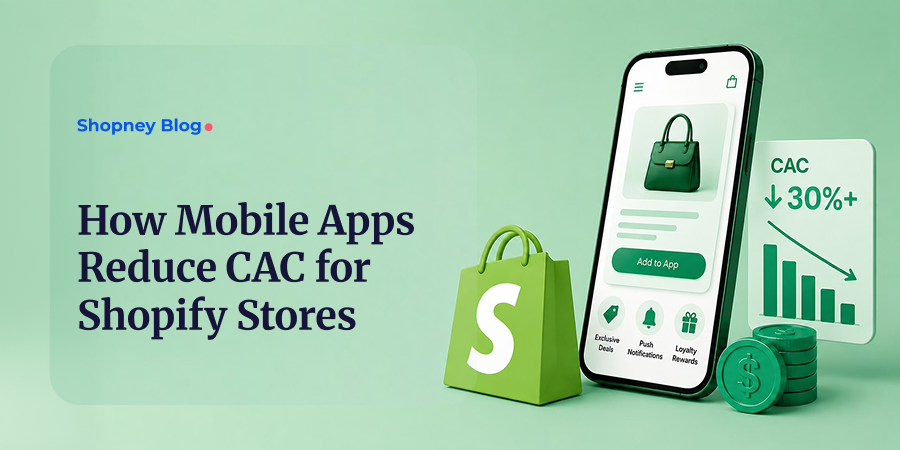

Customer acquisition is getting more expensive.
Shopify brands are spending more on ads, competing for the same attention, and fighting harder to turn first-time visitors into buyers. The problem is not only that ad costs are high. The bigger problem is that many brands keep paying again and again to reach the same people.
That is where mobile apps can make a real difference.
A mobile app does not magically remove acquisition costs. You still need traffic, strong products, and marketing. But a mobile app can help your brand get more value from every customer you acquire.
Instead of paying repeatedly to bring shoppers back through ads, a mobile app gives you a direct channel to reach them, engage them, and encourage repeat purchases.
For Shopify brands that already have mobile traffic, returning customers, and an engaged audience, choosing to turn your Shopify store into an app can help reduce CAC pressure and make customer acquisition more profitable over time.
Let’s break down how.
What Is Customer Acquisition Cost?
Customer Acquisition Cost, or CAC, is the amount your brand spends to acquire one new customer.
The basic formula is simple:
CAC = Total Marketing Spend / Number of New Customers Acquired
For example, if you spend $10,000 on marketing and acquire 200 new customers, your CAC is $50.
That number matters because it shows how expensive it is to grow your customer base.
But CAC does not tell the full story by itself.
A $50 CAC can be a problem if a customer only buys once and never comes back. But the same $50 CAC can be profitable if that customer returns, buys again, joins your loyalty program, responds to campaigns, and keeps purchasing over time.
This is why Shopify brands should not only ask:
“How can we acquire more customers?”
They should also ask:
“How can we get more value from the customers we already paid to acquire?”
That is exactly where a mobile app becomes valuable.
Push Notifications Help Bring Customers Back Without Paying for Every Click
One of the biggest reasons mobile apps help reduce CAC pressure is push notifications.
When you rely only on paid ads to bring shoppers back, every return visit can come with a cost. You pay to reach people who may have already discovered your brand, visited your store, or even purchased from you before.
That creates a frustrating loop.
You acquire a customer once, then keep paying to reach them again.
With a mobile app, push notifications give you a direct way to reconnect with customers without paying for every click.
You can use push notifications to promote:
- New product drops
- Back-in-stock updates
- App-exclusive offers
- Seasonal offers
- Abandoned cart reminders
- Loyalty rewards
- Flash sales
- Personalized recommendations
The key is not to send random messages. The real value comes from sending timely, relevant push notifications that give customers a reason to come back.
For example, instead of running another paid retargeting ad campaign to remind shoppers about a sale, you can send a push notification directly to app users. Instead of paying again to announce a product restock, you can notify customers who are already interested.
That does not mean push notifications replace all paid marketing. They do not.
But they help reduce your dependency on paid channels for repeat engagement.
And that makes the original acquisition cost work harder.
Once a customer installs your app, you have a more direct path to bring them back, re-engage them, and turn one acquisition into multiple purchase opportunities.
Mobile Apps Help Brands Get More Value From the Traffic They Already Paid For
CAC is not only affected by how much you spend on ads.
It is also affected by what happens after someone lands on your store.
If you pay to bring shoppers to your Shopify store but the experience is slow, confusing, or difficult to navigate on mobile, you lose potential customers before they buy.
That means part of your acquisition spend is wasted.
A mobile app can help brands get more value from the traffic they already worked hard to attract.
Why?
Because mobile apps can create a smoother and more familiar shopping experience.
A strong mobile app experience can support:
- Faster load times
- Easier navigation
- Better product discovery
- Personalized product recommendations
- Smoother checkout
- In-app campaigns
- A seamless shopping journey
Think about how people shop on mobile today.
They are used to fast, simple, personalized experiences. Your shoppers don’t want to pinch, zoom, wait for pages to load, or fight through a clunky mobile website. They want to browse quickly, find what they need, and complete the purchase without friction.
A mobile app helps Shopify brands create that kind of experience.
This matters for CAC because conversion efficiency directly affects acquisition efficiency.
If you spend the same amount on marketing but more visitors convert, your customer acquisition becomes more efficient.
For Shopify brands focused on improving mobile performance, a mobile app can be a practical way to reduce marketing costs by converting and re-engaging shoppers more efficiently.
Mobile Apps Reduce Cart Abandonment by Making the Buying Journey Easier
Cart abandonment is painful because it usually happens after you have already done the hard work.
You paid for the click. You got the visitor. The shopper browsed your products. They added something to the cart.
And then they left.
When this happens, your acquisition spend does not turn into revenue.
A mobile app can help reduce cart abandonment by making the buying journey easier from start to finish.
Shoppers are more likely to complete their orders when the experience feels simple, fast, and clear.
Mobile apps can support lower cart abandonment through:
- Better product browsing
- Faster checkout
- Saved customer details
- Push notification cart reminders
- Personalized offers
- Easier navigation back to the cart
- A smoother mobile shopping experience
The difference can be small in the moment, but powerful over time.
A shopper who gets distracted can be reminded with a push notification. A customer who hesitates can receive a relevant app-exclusive offer. A returning customer can check out faster because the experience is already familiar.
This is important because CAC is not just about attracting people.
It is also about not losing them at the final step.
When fewer shoppers abandon their carts, more of your acquisition spend turns into actual revenue. That means your marketing budget becomes more productive without necessarily increasing your ad spend.
Higher LTV Makes CAC More Profitable
CAC becomes much easier to manage when customer lifetime value is strong.
Customer Lifetime Value, or LTV, is the total revenue a customer brings to your brand over time.
If someone buys once and never comes back, your acquisition cost has to be recovered from one order.
But if that customer returns again and again, your original acquisition cost becomes more profitable with every repeat purchase.
This is one of the most important ways mobile apps help Shopify brands.
A mobile app can increase customer lifetime value by encouraging more repeat purchases after the first acquisition.
It gives your brand more opportunities to:
- Bring customers back with push notifications
- Promote new collections
- Recommend relevant products
- Highlight loyalty rewards
- Share exclusive app campaigns
- Keep customers engaged between purchases
- Make repeat buying easier
And when LTV goes up, CAC becomes easier to justify.
A higher CAC is not always bad if the customer brings enough long-term value. The real problem is paying to acquire customers who never return.
Mobile apps help solve that by turning first-time customers into long-term customers.
Mobile Apps Create an Owned Sales Channel for Long-Term Growth
Paid channels are useful, but they are not fully yours.
Ad costs change. Algorithms change. Competition increases. Retargeting becomes more expensive. Platforms decide how much reach you get and how much you need to pay for it.
A mobile app gives Shopify brands something more stable: an owned sales channel.
That means you have a direct place where your customers can shop, engage, and return without depending only on third-party platforms.
An owned mobile app channel gives your brand:
- More direct customer access
- Lower dependency on paid retargeting
- Stronger customer experience
- Better customer retention
- More repeat purchase opportunities
- A direct way to promote campaigns
- A more loyal customer base
The more customers you move into your mobile app, the less you need to depend only on paid channels to generate repeat sales.
This is where the long-term CAC impact becomes clear.
You may use paid ads to acquire a customer for the first time. But after that customer installs your app, you have a direct channel to reach them again.
That reduces the need to keep paying to bring the same customer back.
That is why a mobile app is not just another sales channel. For growing Shopify brands, it can become a retention channel, engagement channel, and repeat purchase channel at the same time.
How Shopify Brands Can Use a Mobile App to Reduce CAC Pressure
A mobile app can support lower CAC pressure, but only if you use it strategically.
Launching the app is not the end goal.
The goal is to get customers into the app, give them a reason to stay there, and use the app to create more repeat purchases.
Here are practical ways Shopify brands can do that.
Offer App-Exclusive Benefits
Customers need a reason to download and keep using your app.
App-exclusive benefits can help create that reason.
You can offer:
- App-only discounts
- Early access to new collections
- Exclusive product drops
- Loyalty point bonuses
- Free shipping offers
- Members-only offers
- First access to sales
The point is not to discount everything.
The point is to make the app feel valuable.
When customers know that your best offers, launches, or experiences are available in the app, they are more likely to install it and come back to it.
Send Push Notifications for Repeat Sales
Push notifications are one of the most powerful ways to drive repeat purchases from your app users.
But they work best when they are relevant.
Instead of sending the same message to everyone, use push notifications based on customer behavior, campaign timing, and product interest.
You can send push notifications for:
- New arrivals
- Back-in-stock products
- Abandoned carts
- Flash sales
- Seasonal campaigns
- Personalized offers
- Loyalty rewards
- Product recommendations
The goal is to bring customers back at the right moment with the right message.
That is how push notifications can help reduce the need for paid retargeting and make your acquisition spend more efficient.
Make Loyalty Programs More Visible
Many Shopify brands have loyalty programs, but customers often forget about them.
A mobile app can make loyalty more visible and easier to engage with.
You can use the app to remind customers about:
- Available points
- Rewards they can redeem
- VIP status
- Loyalty tiers
- Referral benefits
- Special member campaigns
This helps turn loyalty from something hidden in the background into something customers actually notice and use.
When loyalty becomes more visible, customers have more reasons to come back and buy again.
That supports higher LTV, stronger retention, and better CAC efficiency.
Personalize Product Recommendations
Personalization is another way mobile apps help increase repeat purchases.
When customers open your app, they should not feel like they are starting from zero every time.
You can use customer behavior to recommend relevant products based on:
- Browsing history
- Previous purchases
- Recently viewed products
- Similar products
- Frequently bought together items
- Collection interests
Personalized product discovery helps customers find what they are more likely to buy.
This creates a better shopping experience and can increase the value of each visit.
For Shopify brands, this matters because every repeat purchase improves the return on the original acquisition cost.
Choose the Right Mobile App Builder
The app itself matters, but so does the platform you build it with.
A mobile app should make growth easier, not create extra work for your team.
For Shopify brands, the right mobile app builder should help you launch quickly, create a branded shopping experience, connect your ecommerce tools, send push notifications, support retention, and improve mobile conversion.
More importantly, your mobile app builder should work hand in hand with you from day one and continue supporting you after launch, helping you grow your Shopify store through your mobile app.
That’s why it’s worth looking at why Shopify brands choose Shopney when they want to turn their store into a high-performing mobile app.
The goal is to build a mobile sales channel that supports conversion, engagement, retention, and long-term growth.
Last Thoughts
Mobile apps reduce CAC pressure by helping Shopify brands stop paying again and again to reach the same customers.
They help you bring shoppers back through owned channels, convert more of the traffic you already paid for, reduce cart abandonment, increase repeat purchases, and grow customer lifetime value.
That is what makes a mobile app valuable for CAC.
It does not replace your acquisition strategy.
It makes your acquisition strategy more profitable.
Instead of treating every customer as a one-time transaction, a mobile app helps turn that first acquisition into a long-term revenue opportunity.
For Shopify brands that already have mobile traffic, returning customers, and a growing audience, a mobile app can become one of the most effective ways to reduce CAC pressure and build a stronger, more sustainable growth channel.

Share this: