
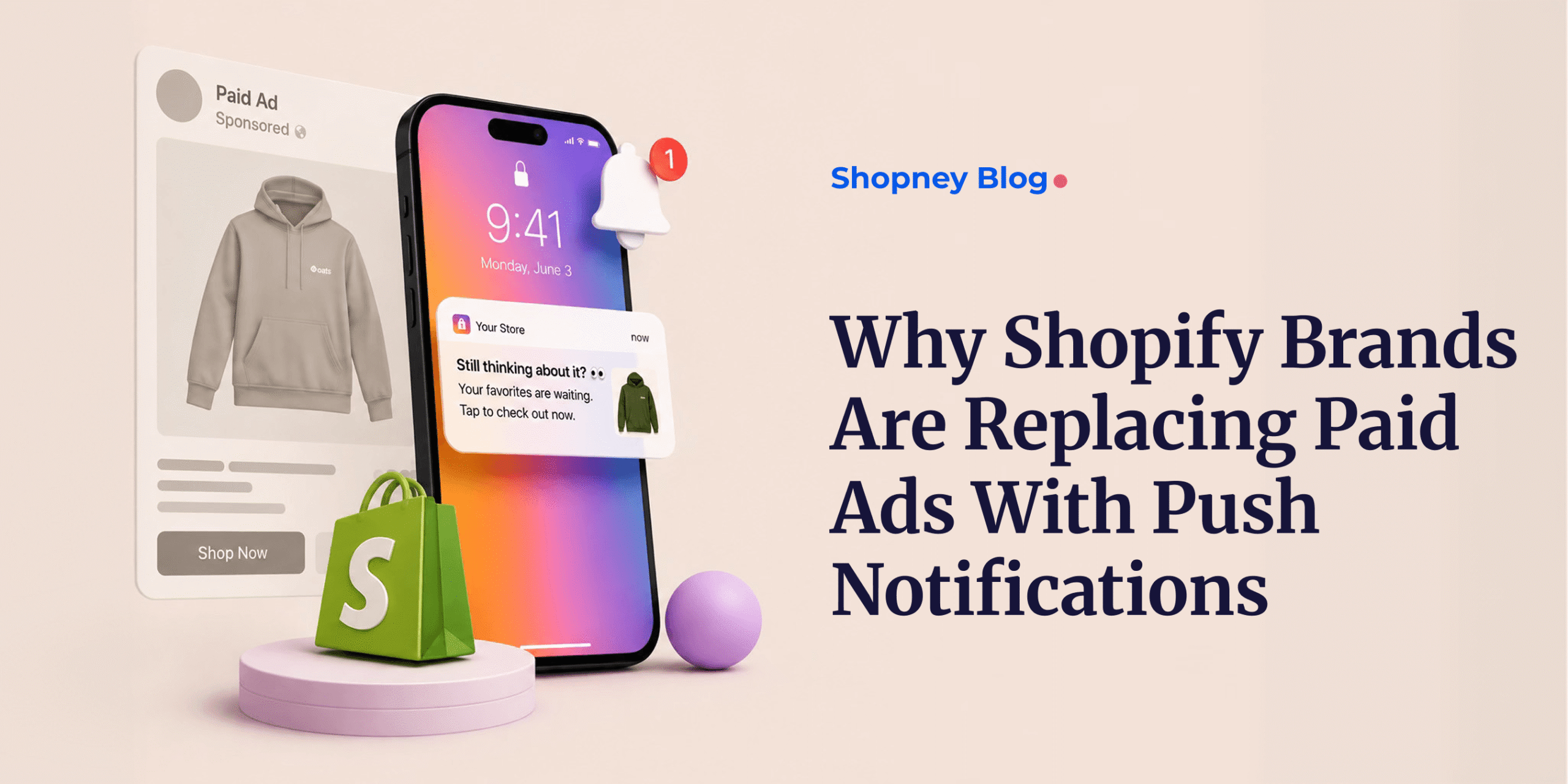

Paid ads still matter for Shopify brands. They help stores reach new shoppers, create visibility, and bring traffic to their products.
But for many ecommerce brands, the problem is not whether paid ads work. The problem is how expensive it becomes when they rely on paid ads for every customer touchpoint.
A shopper visits once.
They browse.
They leave.
They abandon a cart.
They wait for a discount.
They forget about the product.
Then the brand pays again to bring them back.
This is where the shift starts.
Shopify brands are looking for ways to reduce their dependency on paid platforms because ad costs are rising, platform control is limited, and brands need a more direct way to reach shoppers they already worked hard to attract.
Triple Whale reported paid ads CPA at $32.74, up 8.64% from 2024, while conversion rate dropped 6.21%. That shows the pressure clearly: brands are spending more to acquire attention while conversion efficiency becomes harder to maintain.
This is why push notifications are becoming more important.
With a mobile app for Shopify, brands can turn app users into an owned audience. Once customers opt in, push notifications give the brand a direct way to reach them without paying for another ad impression every time.
This makes us wonder why the shift from paid ads towards push notifications is happening?
1. Escalating Ad Costs
Paid acquisition is becoming harder to scale profitably across Meta, Google, TikTok, and other competitive platforms.
More brands are competing for the same attention. Ad auctions are more crowded. Customer acquisition costs are rising. At the same time, shoppers are not always ready to buy after the first click.
This creates a difficult cycle for Shopify brands.
They spend to bring shoppers in, but if those shoppers do not convert immediately, they often need to spend again to bring them back. That means paid ads are not only used for acquisition. They are also used for retargeting, cart recovery, product reminders, promotions, and repeat purchase campaigns.
That is where ad spend starts becoming heavy.
The brand is not only paying to reach new customers. It is also paying repeatedly to reach people who already know the brand.
This does not mean paid ads are unnecessary. They still play an important role in discovery and acquisition. But depending on them for every return visit makes growth more expensive.
Rising ad costs are pushing Shopify brands to look for more efficient ways to reach and re-engage customers.
2. Limited Control Over Paid Platforms
Paid ads also come with a control problem.
Brands do not fully control when, how often, or at what cost they reach their audience. Performance depends on algorithms, bidding competition, platform rules, campaign budgets, and constant changes across advertising platforms.
Even if a brand has strong creative and a good offer, it still has to compete for visibility.
This makes paid ads feel like rented attention.
The brand can reach shoppers as long as it keeps paying. But when costs rise or platform performance changes, the brand has limited control over the outcome.
That is why owned channels are becoming more important.
Shopify brands need channels where they can control the timing, message, audience, and campaign schedule more directly. Email, SMS, web push, and app push all play a role here, but push notifications are especially powerful when the brand has a native mobile app and a strong base of opted-in users.
With push notifications, brands can communicate with customers directly instead of waiting for an algorithm to decide whether the message gets seen.
Paid platforms give brands visibility. Owned channels give brands access.
3. Owned Communication Channel
Push notifications give Shopify brands a direct line to app users.
Once a customer installs the app and allows push notifications, the brand can reach that customer without buying another ad impression. This changes the relationship between the brand and the shopper.
Instead of depending only on paid campaigns to bring people back, the brand can send timely messages directly to the customer’s device.
This is valuable because Shopify brands already spend time and money attracting shoppers. Once that shopper becomes an app user, push notifications help the brand keep the relationship alive.
The customer no longer needs to see another ad to remember the brand.
The brand can send:
- a product drop announcement
- an abandoned cart reminder
- a back-in-stock alert
- a price drop notification
- an app-exclusive offer
- a loyalty reward
- a flash sale reminder
- a personalized campaign
This turns customer attention into an owned communication channel.
That is one of the biggest reasons Shopify brands are shifting part of their marketing focus from paid ads to push notifications. They are not only trying to reduce costs. They are trying to build direct access to the customers they already earned.
4. Cost And Time-Effective Marketing
Push notifications are also cost and time-effective.
Compared to paid ads, push notifications do not require ongoing media spend every time the brand wants to reach app users. Once customers opt in, the brand can send messages directly without paying for each impression.
This makes push useful for quick campaigns.
A Shopify brand can send a push notification for a flash sale, product drop, back-in-stock update, or app-exclusive offer without building a full ad campaign from scratch. The message can be short, timely, and action-focused.
Push notifications are also faster to create than long email campaigns. They do not require heavy design, long copy, or complex campaign setup. A simple message with the right timing and destination can bring customers back into the app quickly.
That makes push especially useful for ecommerce moments that move fast:
- limited-time discounts
- weekend campaigns
- BFCM offers
- new arrivals
- low-stock reminders
- product launches
- seasonal promotions
- app-only campaigns
This is where push notifications support ad spend reduction.
Instead of creating and funding a paid campaign for every announcement, Shopify brands can use push as a direct communication layer for customers who already showed interest.
Push helps brands communicate quickly without burning budget on every campaign.
5. Instant Communication That Gets Noticed
Push notifications are built for immediacy.
They appear directly on the customer’s device, which makes them useful for time-sensitive messages. Unlike email, they do not depend on the customer opening an inbox. Unlike paid ads, they do not depend on whether the platform decides to show the campaign at the right moment.
This matters for Shopify brands because many ecommerce campaigns depend on timing.
A flash sale needs attention now.
A product drop needs visibility when it launches.
A back-in-stock product needs to reach shoppers before it sells out again.
A cart reminder works best while the product is still fresh in the customer’s mind.
Push notifications help brands reach customers at those moments.
Pushwoosh reports ecommerce and retail push CTR benchmarks around 3.78% on Android and 3.05% on iOS. That makes push a measurable engagement channel, especially when messages are timely and relevant.
This is why push notifications can be stronger than generic promotions.
They do not only send a message. They send it at the moment when the customer has a reason to care.
For Shopify brands trying to keep app users engaged, this instant reach is one of the biggest advantages of push notifications.
6. Re-Engagement And Customer Retention
Push notifications are especially valuable for re-engagement and retention.
Paid ads are often used to bring back people who already know the brand. But if a customer already bought before, installed the app, abandoned a cart, or browsed products, the brand should not always need to pay again to reach them.
Push notifications give brands a direct way to bring these customers back.
They can be used to re-engage:
- previous buyers
- inactive app users
- cart abandoners
- loyal customers
- wishlist users
- product viewers
- customers interested in specific categories
- shoppers waiting for restocks or discounts
This matters because retaining customers is usually more cost-efficient than acquiring new ones. Harvard Business Review states that acquiring a new customer can be 5 to 25 times more expensive than retaining an existing one.
So when brands use push notifications to bring existing customers back, they are not only increasing engagement. They are also improving the economics of their marketing.
Instead of constantly spending to find new customers, brands can get more value from the customers they already acquired.
This is where push notifications connect directly to customer retention. They help brands stay present, bring customers back, and encourage repeat purchases without relying on paid ads every time.
Push reduces ad dependency by helping brands get more value from the audience they already have.
7. Abandoned Cart Recovery
Abandoned carts are one of the clearest examples of where push notifications can replace paid retargeting.
Cart abandonment is a common challenge for Shopify stores. A shopper may add products to the cart, get distracted, compare prices, wait for later, or simply leave before completing the purchase.
Many brands use retargeting ads to bring those shoppers back.
But if the shopper is an app user, push notifications can create a more direct recovery path.
Instead of paying for another ad impression, the brand can send an abandoned cart push notification while the product is still fresh in the shopper’s mind.
For example:
“Still thinking it over? Your cart is waiting.”
Or:
“Your favorites are still in your cart. Complete your order before they sell out.”
These messages work because they are connected to a real action the shopper already took. The customer showed intent. Push simply brings them back to complete the journey.
This helps brands turn mobile traffic into sales without depending only on paid retargeting.
Push can replace paid retargeting for one of the most common lost-sales moments.
8. Better Shopping Experience
Push notifications are not only for promotions.
They can also improve the shopping experience by giving customers helpful updates at the right time.
A good push notification does not always need to say “buy now.” Sometimes it can simply make the customer journey easier.
For example, brands can use push notifications for:
- order updates
- shipping notifications
- delivery reminders
- back-in-stock alerts
- price drop alerts
- wishlist updates
- holiday delivery deadlines
- important store announcements
- product availability updates
These messages help customers stay informed without needing to check the website, inbox, or order status page manually.
This creates convenience.
A customer does not need to search for whether a product is available again.
They get notified.
They do not need to keep checking for a price drop.
They get notified.
They do not need to wonder where their order is.
They get notified.
That makes the mobile shopping experience smoother and more useful.
This is important because push notifications should not only be seen as a sales tool. They are also a service tool. When used well, they help the brand communicate better and make the customer experience more convenient.
Push does not only promote sales. It also supports the shopping journey.
9. Personalization Opportunities
Push notifications become stronger when they are personalized.
A generic message sent to every customer may get attention once, but it can become easy to ignore. Personalized push notifications feel more relevant because they are connected to the customer’s behavior, interest, or purchase history.
Epsilon found that 80% of consumers are more likely to purchase when brands offer personalized experiences. This is important for Shopify brands because push notifications can be personalized around real shopping behavior.
For example:
- shoppers who browse a certain category can receive new arrival alerts
- returning customers can receive loyalty rewards
- new app users can receive welcome offers
- shoppers who viewed a product can receive price drop alerts
- customers interested in sold-out products can receive restock alerts
- loyal customers can receive early access to campaigns
- inactive customers can receive win-back offers
This makes push feel less like a broadcast and more like a helpful message.
Personalization also protects engagement. If customers receive messages that match their interests, they are more likely to pay attention. If every customer receives the same generic promotion, push can lose its impact.
The value of push notifications is not only that they are direct. It is that they can be direct and relevant at the same time.
Personalization makes push feel useful instead of random.
10. Data-Driven Marketing Insights
Push notifications also give Shopify brands useful campaign data.
Every push campaign can show how customers respond. Merchants can track opens, clicks, conversions, timing, offer performance, and product interest.
This helps brands understand what actually works.
For example, push performance can show:
- which offers get the most clicks
- which products attract attention
- which campaigns drive purchases
- which timing works best
- which customer segments respond more strongly
- which messages bring users back into the app
These insights can improve more than push campaigns. They can also support broader marketing decisions.
If a product drop gets strong push engagement, the brand may use that insight for email, homepage merchandising, or future paid campaigns. If a discount message performs better than a free shipping message, the brand can adjust future offers. If a certain customer segment responds well to early access, the brand can build stronger VIP campaigns.
This turns push notifications into more than a communication channel.
They become a feedback loop.
Brands can use push data to understand customer behavior, improve campaigns, and make better decisions across their marketing strategy.
Conclusion
Paid ads are still useful for discovery and acquisition. Shopify brands will continue using Meta, Google, TikTok, and other platforms to reach new shoppers and create visibility.
But relying on paid ads for every promotion, cart recovery, return visit, and repeat purchase campaign makes growth expensive.
Push notifications help reduce that dependency.
They give Shopify brands a direct, owned, timely, and cost-effective way to reach customers they already earned. They help brands act faster, personalize better, recover carts, improve retention, and create a better shopping experience.
The shift is not about removing paid ads completely.
It is about using paid ads and push notifications for the right jobs.
Paid ads create visibility.
Push notifications create direct re-engagement.
That is why more Shopify brands are replacing parts of their paid ad strategy with push notifications.
They want to reach customers directly, reduce unnecessary retargeting spend, and stop paying for every return visit.
Want to reduce your dependency on paid ads with a branded mobile app and direct push notifications? Book a demo with Shopney and see how your Shopify store can turn app users into a stronger retention and re-engagement channel.
Share this: