
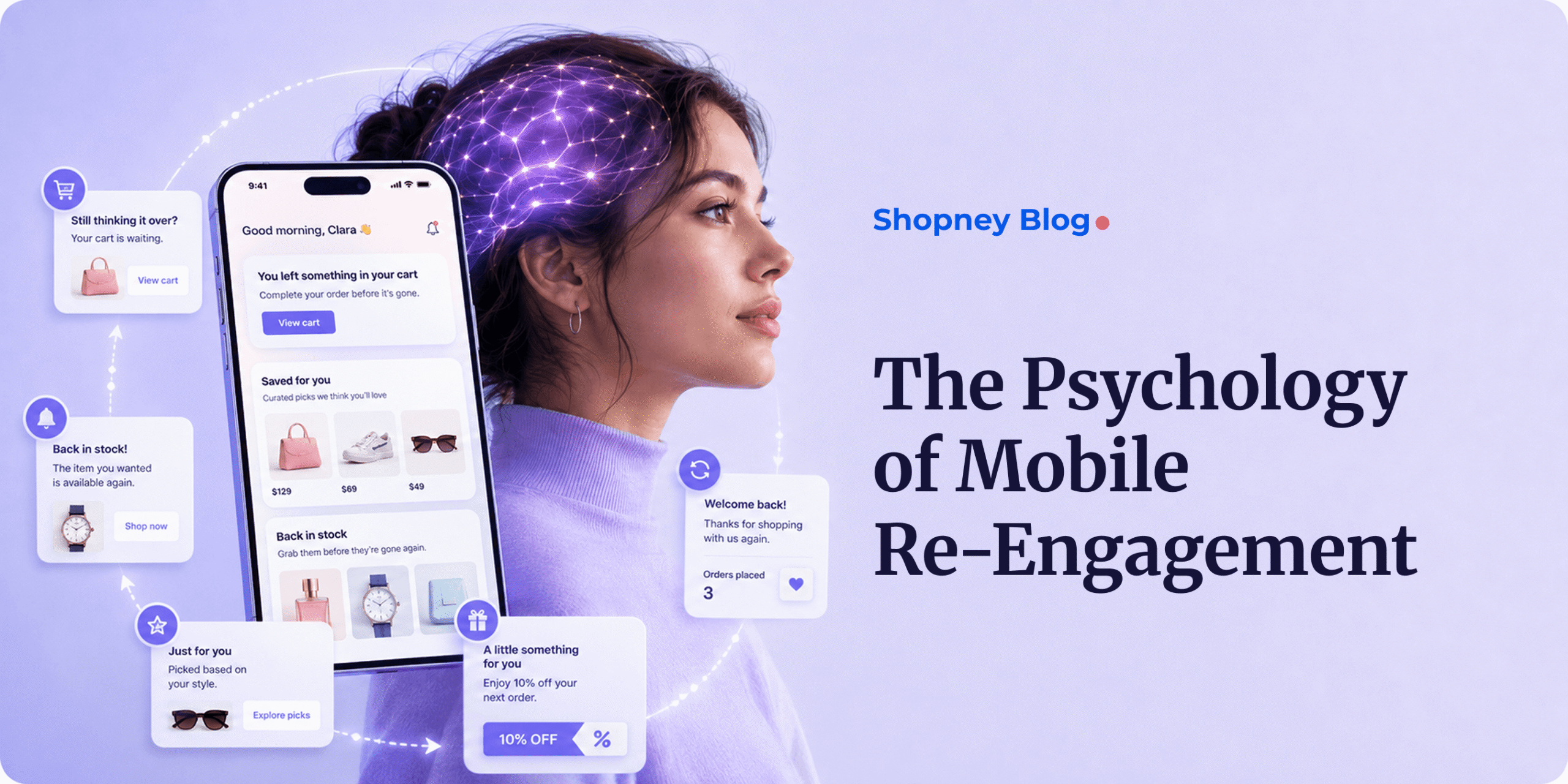

Re-engagement in mobile commerce is not just about sending more messages to users who stopped browsing.
It starts earlier in the customer journey.
A user first needs to engage with the brand, find something relevant, convert or show purchase intent, and then receive a meaningful reason to return. Without that first layer of engagement, re-engagement becomes random. The brand is trying to bring someone back without understanding what made them interested in the first place.
This is why effective re-engagement is both a retention strategy and a psychology strategy.
Mobile apps are especially powerful for this because they stay close to the customer. The app is already on the user’s device, the brand can communicate through push notifications and in-app messages, and the experience can be personalized based on previous behavior.
A customer may return because they do not want to miss a limited offer. They may reopen the app because a saved product is back in stock. They may complete a purchase because checkout feels easy. They may come back again because the app remembers their preferences and makes the next action feel simple.
So effective mobile commerce re-engagement is not only about bringing users back. It is about bringing them back with the right message, at the right moment, in a way that supports long-term retention.
For Shopify brands, a mobile app for Shopify can make this easier because it gives the brand a direct, visible, and repeatable channel for bringing customers back.
1. Re-Engagement Starts With Engagement
Re-engagement does not happen in isolation.
Before a brand can bring a user back, there needs to be something to bring them back to.
The user must first engage with the brand in some way. They may browse products, view a collection, save an item, add something to cart, join a loyalty program, open a previous campaign, or make a purchase.
These first actions create the foundation for re-engagement.
If the brand understands what the user engaged with, it can create a more meaningful reason to return.
A user who viewed a product can receive a back-in-stock alert.
A user who added to cart can receive an abandoned cart reminder.
A customer who purchased before can receive a reorder reminder.
A loyalty member can receive a reward update.
A user who browsed a category can receive a personalized product suggestion.
Without this first engagement layer, re-engagement becomes generic.
The brand may still send a message, but the message may not connect to anything the user actually cared about. This is where many re-engagement efforts become weak. They try to bring people back without understanding the original reason they showed interest.
Effective re-engagement starts by understanding what the user already did, what they cared about, and what kind of return message would feel useful.
This is also why brands need to increase mobile app engagement before they can build stronger re-engagement. The more meaningful the first engagement is, the more relevant the return moment can become.
2. Conversion Creates Stronger Re-Engagement Signals
The next step in the flywheel is conversion.
When a user converts, or even gets close to converting, the brand learns something important about their intent.
A purchase, cart addition, wishlist save, checkout start, product view, or loyalty action gives the brand a stronger signal than a random visit.
This matters because re-engagement should not treat every user the same.
A first-time visitor may need trust-building.
An abandoned cart user may need a timely reminder.
A repeat buyer may need convenience.
A loyalty customer may need reward visibility.
A dormant customer may need a more personal reason to return.
Mobile commerce re-engagement becomes more effective when the brand uses these signals to decide what kind of message to send.
For example, a user who started checkout does not need the same message as someone who only viewed the homepage. A customer who bought a product last month does not need the same message as someone who abandoned a cart yesterday.
Each behavior gives a different clue.
That clue helps the brand understand what kind of re-engagement moment makes sense.
A cart addition shows purchase intent.
A wishlist save shows interest.
A previous purchase shows trust.
A loyalty action shows relationship depth.
A category view shows product preference.
The stronger the signal, the more specific the re-engagement can be.
This is where re-engagement also connects to conversion. When brands use user behavior to guide the next message, they can boost Shopify mobile conversions by bringing customers back to the action they were already close to taking.
3. Re-Engagement Is A Retention Mechanism
Re-engagement is closely tied to retention.
The goal is not only to get one more app open, one more click, or one more purchase. The deeper goal is to keep customers connected to the brand over time.
This is why re-engagement should not be treated as a short-term promotional tactic only.
If every re-engagement message is just a discount, customers may learn to return only when there is a sale.
But if re-engagement is built around relevance, convenience, reminders, rewards, and personalized value, it can strengthen the customer relationship.
Retention-focused re-engagement asks:
- What makes this customer return?
- What value can we remind them of?
- What product or action is relevant now?
- What friction can we remove?
- What habit can we support?
- What reason can we give them to stay connected?
This changes the way brands think about re-engagement.
Instead of asking only, “How do we get this user to open the app again?” the better question is, “How do we make returning feel useful enough that they want to do it again?”
That is the retention mindset.
A strong re-engagement strategy should not only reactivate users. It should help create repeatable return moments that make customers more likely to stay connected with the brand.
That is how re-engagement helps brands increase customer retention with a mobile app.
4. Relevance Makes Users Pay Attention
The first psychological condition for re-engagement is relevance.
Users are more likely to respond when the message feels connected to their interests, behavior, or previous actions.
A generic message asks the user to decide whether it matters.
A relevant message already explains why it matters.
“You left something in your cart” is more relevant than “Shop now.”
“Your saved item is back in stock” is more relevant than “New arrivals are here.”
“You have points waiting” is more relevant than “Check our offers.”
“Your favorite category has new products” is more relevant than “Browse the app.”
In mobile commerce, relevance matters even more because push notifications and in-app messages are highly visible. If the message is not useful, it can feel intrusive.
This is why brands need to be careful with re-engagement messages.
A user’s phone is personal. A message that appears there needs to feel useful enough to deserve attention.
Relevance helps with that.
When the message connects to something the user already did, wanted, saved, viewed, or bought, it feels less random. It feels more like a continuation of the customer journey.
That is what makes users more likely to pay attention.
5. Loss Aversion Give Users A Reason To Return
Loss aversion is one of the strongest psychological triggers in mobile commerce re-engagement.
People often react when they feel they may lose access to something they already value.
In mobile commerce, this can appear when users are reminded of something they may miss, lose, or forget.
Examples include:
- abandoned cart reminders
- expiring discounts
- low-stock alerts
- saved items selling out
- loyalty points expiring
- limited-time rewards
- unfinished checkout reminders
The point is not to create fake pressure.
The point is to remind users of real value they already showed interest in.
If a customer added a product to cart, saved an item, or earned a reward, the re-engagement message is connected to something they already cared about.
That makes the reminder more meaningful.
A message like “Your reward expires soon” works because the customer already has something available to use.
A message like “The item in your cart is almost sold out” works because the customer already showed purchase intent.
A message like “Your saved product is back in stock” works because the customer already showed interest.
The strongest missed-opportunity messages do not force urgency. They simply bring attention back to something the user may still want.
That is what makes the return feel logical.
6. FOMO Creates A Reason To Come Back Now
FOMO works because it reduces the feeling that the user can act later.
If a product is limited, a reward is expiring, or a campaign is ending soon, the user has a clearer reason to return now instead of postponing the action.
In mobile commerce, this can be supported through:
- limited-time offers
- countdown campaigns
- low-stock alerts
- early access drops
- app-exclusive launches
- seasonal campaigns
- expiring rewards
Mobile apps are effective here because the message can reach the user quickly.
A push notification or in-app campaign can turn passive interest into immediate action.
But FOMO needs to be used carefully.
If everything is urgent, nothing feels urgent.
Customers can quickly learn to ignore urgency if it feels exaggerated or repeated too often. That is why FOMO works best when it is real, specific, and connected to something the user may actually care about.
A low-stock alert for a product the user viewed is stronger than a general “Hurry up” message.
An app-exclusive early access drop is stronger than a vague limited-time promotion.
An expiring reward reminder is stronger than a random discount campaign.
FOMO helps re-engage users when it gives them a timely and believable reason to return.
7. Rewards And Incentives Make Returning Feel Worth It
Users are more likely to re-engage when the return action feels rewarding.
Mobile commerce can support this by making the next step simple, valuable, and satisfying.
This can include:
- one-tap access to the app
- saved login
- fast checkout
- visible rewards
- instant discount activation
- easy cart recovery
- quick reorder
- immediate confirmation after purchase
- reward points after action
When opening the app leads to a clear reward, useful product, saved cart, or easier checkout, the user learns that returning is worth it.
This supports retention because the app becomes associated with useful, low-effort actions.
Rewards and incentives should not only be treated as discounts.
They can also include convenience, loyalty progress, app-exclusive access, personalized offers, faster checkout, or the satisfaction of completing something quickly.
For example, a user may return because they have points to redeem.
Another user may return because they can recover their cart easily.
Another may return because the app gives them early access to a new collection.
Another may return because reordering takes only a few taps.
The common idea is simple: the return should feel valuable.
When users repeatedly receive value after coming back, re-engagement becomes easier over time.
8. Ease Of Use Reduces The Effort To Return
Ease of use means the experience feels simple, familiar, and easy to continue.
In mobile commerce, this matters because users are often distracted, multitasking, or acting quickly.
If the app feels confusing, slow, or heavy, the user may drop off again even after re-engaging.
A mobile app can reduce this effort through:
- familiar layout
- saved preferences
- simple navigation
- clear product paths
- easy cart access
- fast checkout
- visible rewards
- clear campaign routing
- personalized sections
This is where the mobile app experience matters as much as the message.
A push notification may bring the user back, but the app experience decides whether they stay.
If a customer taps a cart reminder and lands directly in the cart, the path feels easy.
If a customer taps a reward reminder and immediately sees how to use the reward, the message feels useful.
If a customer taps a product alert and lands on the right product page, the next action feels natural.
But if the user has to search again, log in again, or figure out what to do next, the re-engagement moment can lose power.
Ease of use supports re-engagement because it removes friction from the return path.
9. Habit Loops Turn Re-Engagement Into Repeated Behavior
Effective re-engagement can create a habit loop.
The loop looks like this:
Trigger: push notification, reward reminder, app icon, back-in-stock alert, campaign message.
Action: open the app, browse, save, add to cart, reorder, check rewards, complete purchase.
Reward: discount, product discovery, convenience, loyalty points, order update, faster completion.
Repeat: the user learns that returning to the app is useful.
This is important for retention because the goal is not just one return visit.
The goal is to make returning feel natural over time.
When users repeatedly receive useful triggers and experience useful outcomes, the app becomes part of their shopping routine.
This does not mean every user will open the app every day.
It means that when the right need appears, the app becomes an easy place to return.
A customer may open it when they need to reorder.
Another may open it when they receive a reward reminder.
Another may open it when a favorite product returns.
Another may open it when a new collection drops.
Over time, these repeated return moments create stronger app habits.
Re-engagement becomes more than a campaign. It becomes part of how the customer interacts with the brand.
10. Social Proof Reassures Users Before They Return
Social proof can also support re-engagement.
Sometimes users do not return because they are unsure. They may be interested, but still hesitant.
Reviews, ratings, customer photos, bestseller labels, user-generated content, and community signals can reduce that hesitation.
In mobile commerce, social proof can be used inside the app experience or connected to re-engagement messages.
For example:
A user who abandoned a product may return when they see that it has strong reviews.
A user browsing a category may be influenced by bestseller labels.
A customer may feel reassured by user-generated photos or customer testimonials.
A product drop may feel more attractive when the brand shows community interest.
Social proof validates the decision to return.
It tells the user that other customers bought, liked, reviewed, or trusted the product.
This is especially useful when the customer already showed interest but did not complete the action.
A review, rating, or bestseller signal can reduce hesitation and make the return feel safer.
For mobile commerce, social proof works best when it appears close to the action.
If a customer returns to a product page, reviews should be easy to see.
If a customer opens a campaign, trusted signals should support the offer.
If a product is popular, that popularity can help the customer feel more confident continuing.
11. Consistent Communication Keeps The Brand Present
Re-engagement is not only about one strong message.
It also depends on consistency.
If the brand communicates randomly, users may forget the app or ignore the messages.
If the brand communicates too often, users may feel overwhelmed.
The goal is to create a consistent rhythm that keeps the brand present without becoming annoying.
This can include:
- post-purchase updates
- reward reminders
- product recommendations
- reorder reminders
- seasonal campaigns
- personalized offers
- app-exclusive updates
- loyalty messages
Consistency supports retention because users become familiar with the brand’s presence.
They know what kind of value to expect, and they are more likely to respond when the message is relevant.
This is also where timing matters.
Not every user needs the same frequency.
A repeat buyer may appreciate reorder reminders.
A loyalty customer may respond to reward updates.
A new customer may need post-purchase communication.
A dormant user may need a stronger reason to return.
Consistent communication does not mean sending the same message to everyone all the time.
It means maintaining a reliable presence with messages that match the customer’s stage, behavior, and relationship with the brand.
The right rhythm helps keep the brand present without turning re-engagement into noise.
12. Personalization Connects The Trigger To The User
Personalization is what connects psychology to the individual customer.
The same trigger does not work for everyone.
One user may respond to urgency.
Another may respond to rewards.
Another may respond to product recommendations.
Another may respond to convenience or reorder reminders.
Mobile apps can personalize re-engagement based on:
- purchase history
- browsing behavior
- abandoned carts
- saved items
- customer tags
- loyalty status
- location
- product preferences
- previous campaign engagement
This makes re-engagement more effective because the trigger feels connected to the user’s actual behavior.
Personalization also supports retention because users are more likely to stay engaged when the brand feels relevant over time.
A customer who repeatedly buys skincare should not receive the same experience as someone browsing shoes.
A loyalty member should not receive the same message as a first-time visitor.
A customer with an abandoned cart should not be treated the same as someone who has not opened the app in months.
Personalization helps the brand choose the right reason to bring each user back.
This is where Shopify mobile app integrations can also support the re-engagement experience by connecting loyalty, reviews, subscriptions, customer data, and marketing tools into the app journey.
The more connected the experience is, the easier it becomes to make re-engagement feel relevant.
13. Effective Re-Engagement Builds Long-Term Retention
The goal of re-engagement is not only to reactivate dormant users. It is to keep customers moving through the relationship with the brand.
Engagement creates interest.
Conversion creates stronger intent.
Re-engagement brings the customer back.
Retention grows when those return moments become consistent and valuable.
Mobile apps support this because they combine visibility, direct communication, personalization, convenience, and repeatable habit loops.
When done well, re-engagement helps customers return not just because they were reminded, but because returning feels relevant, easy, and rewarding.
This is the difference between short-term reactivation and long-term retention.
A short-term reactivation message may get one app open.
A retention-focused re-engagement strategy helps customers build a repeated relationship with the brand.
It gives them useful reasons to return, makes the return path easier, and reinforces the value of staying connected.
That is why effective re-engagement should not be measured only by immediate clicks.
Brands should also look at whether users keep coming back, whether repeat purchases increase, whether loyalty engagement improves, and whether app users become more active over time.
The strongest mobile commerce re-engagement strategies are the ones that turn return visits into long-term retention.
Conclusion
Effective re-engagement in mobile commerce is not just about sending more push notifications or running more campaigns.
It starts with engagement, continues through conversion, and becomes powerful when the brand understands why a user would return.
Relevance, missed opportunities, FOMO, rewards, incentives, ease of use, habit loops, social proof, consistent communication, and personalization can all help users come back.
But these triggers work best when they support retention, not just short-term clicks.
Mobile apps give brands the right environment for this because they are visible, direct, personal, and convenient.
Effective mobile commerce re-engagement works when brands use psychology to bring users back in a way that feels relevant, easy, timely, and worth repeating.
To see how Shopney can help you build a mobile app experience that supports engagement, re-engagement, and retention, Book a demo with Shopney.
Share this: